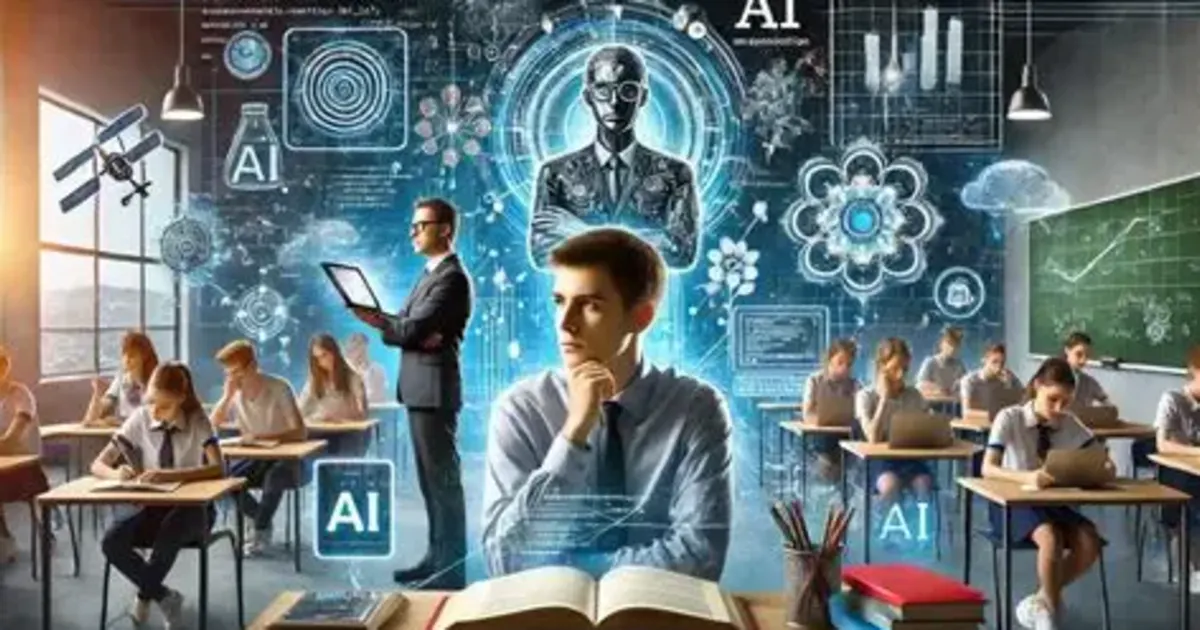
Artificial intelligence is creeping into classrooms faster than many parents or teachers expected, and it leaves us with a complicated question: is this the next big step forward in education or a risk that undermines what schools are meant to do? For some, AI looks like a partner that can adapt to each child, lighten the load for teachers, and bring creativity to lessons. For others, it feels like a shortcut that weakens effort, threatens teachers’ jobs, and makes learning less personal. The answer isn’t simple, because the outcome depends almost entirely on how society chooses to handle it.
You can already see how powerful these tools are. A student stuck on algebra can ask for help and get a clear explanation in seconds. Someone preparing for an English exam can practice writing or conversation without waiting for a teacher’s feedback. Teachers; to get benefit and lesson plans can be generated quickly, exercises adjusted for different levels, even attendance and grading can be streamlined. What once took hours of paperwork can now be done with a few clicks, giving teachers more time for actual teaching. In that sense, AI has the role of an assistant rather than a replacement, and that possibility is what excites many educators. Still, the downside shows up just as clearly. If students rely too much on automated tools to draft essays, solve assignments, or polish presentations, they may never build the thinking muscles that education is supposed to strengthen. Yet AI offers an easy way out, where the real learning happens but here is always struggling with a problem. Some teachers already suspect assignments handed in are more the product of algorithms than of genuine student work. That might mean higher scores on paper but weaker skills in reality. Education becomes shallow if it is only about fast answers.
Another layer is inequality. Wealthier families and schools can afford advanced platforms, while underfunded schools may fall behind. Digitally, there is discrimination between students as one group of students gets more updated tools and some are left with outdated tools. Education has long been praised as the path to fairness, a way for children from any background to rise. But if AI becomes something only a few can access properly, it risks turning that fairness upside down. Unless governments and institutions make access equal and rights are provided to all , the gap between privileged and less privileged students may only grow. Teachers today are under pressure from many sides. Some are relieved that new technology can handle routine and exhausting work, freeing up their time. At the same time, there is an uneasy thought: what if these tools begin to make teachers look less important? A program might be able to grade papers, design quizzes, or even break down difficult ideas. But it will never sense when a student is quietly falling behind, and it cannot inspire real enthusiasm for a subject the way a teacher’s passion can. If schools begin to see AI only as a shortcut to save money, the danger is an education system that looks efficient on paper but loses its soul.
It is easy to reduce the conversation to extremes, but reality is far more mixed. AI is neither a miracle cure nor an automatic threat. Like any tool, its value depends on how people use it. The responsibility does not fall on machines it falls on teachers, policymakers, and families. Students need to learn when to rely on AI and when to step away from it. Teachers must be trained to guide technology rather than feel replaced by it. Governments also have a role to play in making sure every student has equal opportunities. When guided with care and purpose, new practices can add strength to the learning process instead of weakening what education truly stands for. The question that follows is whether these changes will serve as real help or create new risks. The reality is that outcome could unfold. If schools lean too much on it, they risk producing students skilled at shortcuts but weak in creativity and independent thought. It is not possible to completely get rid of it because rejecting it make nations fail to prepare learners for a world where technology is shaping every career. But if a balance is struck where software manages repetitive work while teachers keep the human bond alive classrooms may not just survive but grow stronger in the process.
The choice does not lie in the technology itself; it lies in how people decide to use it. Education has always adapted to new tools; the challenge now is to adapt without losing what makes learning deeply human.