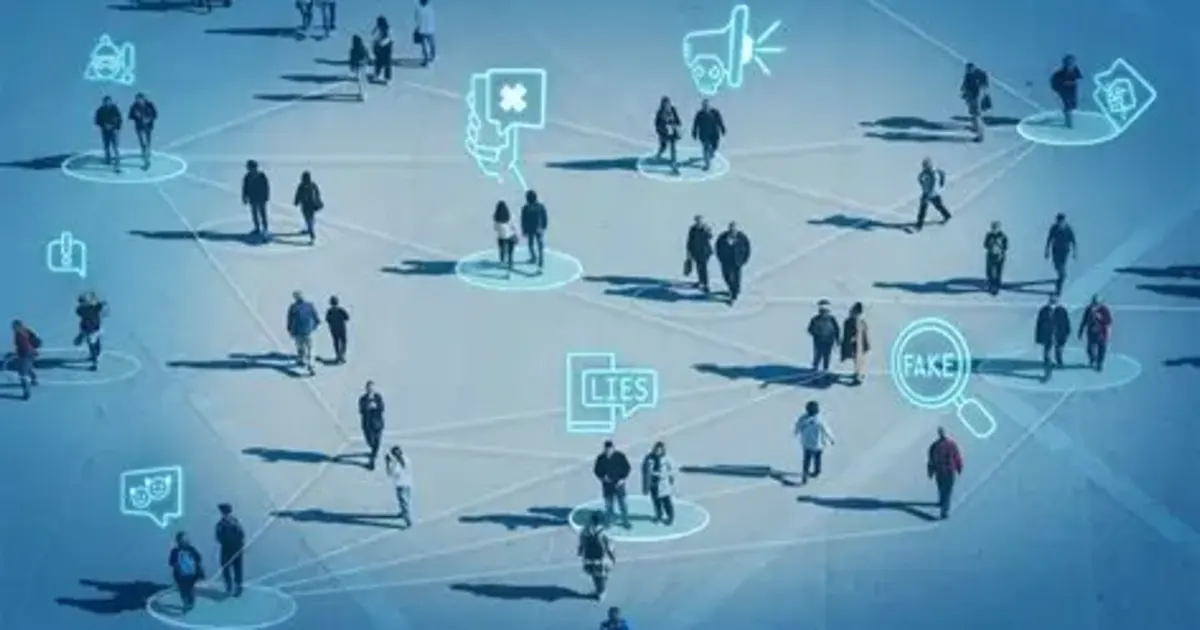
Artificial Intelligence (AI) is changing virtually every aspect of human ranging from health and finance to art and education. But among its numerous accomplishments, one of its most disconcerting side effects is that it can warp reality itself. The same algorithms that compose grammatical essays, create photorealistic images, and clone human voices are now employed to fool, polarize, and manipulate people. With AI technology becoming increasingly powerful and ubiquitous, disinformation is no longer a fringe annoyance; it is a deep threat to democracy, public health, and social stability.
The statistics are sobering. A 2024 survey by the Pew Research Center revealed that 61 percent of Americans anticipate AI-generated deepfakes will greatly heighten political misinformation within five years, but only 15 percent think society is ready to cope with it. The World Economic Forum's Global Risks Report 2024 listed "AI-driven disinformation and misinformation" as one of the top five global risks of the next decade-ahead of terrorism and infectious disease. The threat is already evident. A study conducted by Nature Human Behavior and published in June 2024 found that individuals were statistically more probable to rate AI-written news as true than actual human-composed articles, with the accuracy difference being mere three to four percent. The deep fake economy is growing at breakneck pace: Sensity AI informed us that online deep fake videos are doubling every half-year, and over 95 percent are malicious or deceptive content. Real-world examples show the risk. Early 2024 saw imposter robocalls in President Joe Biden's voice going around ahead of the New Hampshire primary, telling voters to remain at home. AI-augmented hoaxes were seen in elections in Slovakia and in India, where deep fake videos featuring major political figures went viral on WhatsApp in a matter of hours. These are not one-off tricks they are the harbinger of an age when political realities can be convincingly constructed by anyone with a laptop.
AI amplifies disinformation through a variety of strong mechanisms. Large language models and text-to-image systems can generate convincing text, images, and video in seconds. What used to take a state-backed propaganda department can now be done by an individual. A 2023 Brookings Institution report warns that AI significantly reduces the cost of generating high-quality falsehoods, enabling bad actors to "industrialize deception." Social media exacerbates the problem by using AI to personalize content, and their algorithms reward engagement. Brookings and MIT research finds that sensational or emotionally charged content characteristics of disinformation get more likes, shares, and comments, ensuring it spreads faster than thoroughly vetted reporting. Consequently, fabricated tales tend to overwhelm accurate ones by orders of magnitude. Simultaneously, AI-enabled bots can post, respond, and learn in real time, overwhelming platforms with synchronized messages. During the Russia–Ukraine war, scholars recorded AI-powered networks distributing conflicting narratives to plant disinformation and erode confidence in governments as well as media institutions. In contrast to previous generations of bots, these platforms can mimic human patterns of dialogue, rendering detection exponentially more challenging.
The consequences reach far beyond personal dishonesty. When citizens are unable to separate fact from fiction, confidence in media, government, and science declines. Harvard Kennedy School scholars characterize this as "truth decay," a syndrome that undermines democratic deliberation and discredits evidence-based policymaking. The COVID-19 pandemic provides a useful warning. Misinformation about vaccines fed by AI widely circulated on Facebook, TikTok, and WhatsApp. A 2023 study by the MIT Media Lab estimated that vaccine misinformation lowered vaccination intent by as much as 20 percent in some groups. The next health crisis or a high-stakes election may suffer even more from AI-generated deception as it is increasingly difficult to find. AI is not evil in itself; it reflects the purposes of those who use it. The same tools that are being developed to produce falsified content are also being developed to combat disinformation. OpenAI, Microsoft, and Google are testing digital watermarking in an attempt to tag AI-made content. Start-ups like TrueMedia and Reality Defender are developing the ability to detect deepfakes in real time. Regulators are getting involved too. The European Union's Digital Services Act now obliges major platforms to evaluate and minimize systemic risks, such as AI-based disinformation. The U.S. Labeling Act proposal aims to make unambiguous labeling of synthetic material obligatory. But technology and regulation are stuck in an arms race: whenever there is a new detection technique, generative methods find ways to circumvent defenses.
Fighting AI-driven disinformation means needing a multi-layered solution. Governments need to compel transparency of AI systems, from obligatory marking of synthetic content to unveiling of algorithmic procedures. Regulation must be internationally coordinated, as disinformation can travel easily across borders. Social media platforms have to spend on detection and moderation, even at the cost of lower engagement or revenues. The platforms can't pretend to be neutral when their algorithms amplify dangerous lies. Developers ought to include watermarking, provenance tracking, and "red-teaming" to detect weaknesses before release. Independent audits can keep companies honest on safety claims. Lastly, the public is the ultimate bulwark. Educational campaigns and critical thinking programs can enable people to challenge sources, check facts, and resist emotionally manipulative material. Some critics warn that heavy regulation could stifle innovation, slowing beneficial uses of AI in medicine, education, and climate research. This is the innovation dilemma: restrict AI to curb disinformation, or risk unchecked growth that invites abuse. The solution is not to halt progress but to embed ethical safeguards from the start. Responsible AI development should be treated as a core design principle, not an afterthought.
AI is not just a piece of technology; it is a multiplier of human intention. Its capacity to produce and disseminate plausible lies more quickly than any other medium requires immediate action. Without concerted efforts by governments, tech companies, educators, and civil society, AI-based disinformation could undermine the very basis of democratic discussion. The stakes are too high. In an age where believing one's eyes is no longer possible, the battle for truth is not optional. it is a matter of survival. Our shared response will decide whether AI is used as an instrument for illumination or an instrument of mass deception.