In Pakistan, where the number of smartphones exceeds that of many essential items and social media serves as a primary news source for numerous individuals, a critical question arises: Is technology aiding our learning or misleading us? In recent times, the perception that digital platforms serve as unbiased channels of information can no longer be taken at face value. Instead, we find ourselves caught in a dangerous interaction: powerful instruments designed to spread knowledge are now spreading falsehoods, distortions, and confusion. This is not a simple battle of “good technology vs. bad technology.” Rather, it is a complicated discussion about the connections between human intentions, societal influences, and trust. At every turn, technology presents us with choices and consequences.
The Potential and the Risk
When social media was initially introduced to Pakistan, it brought hopes for a change. Underrepresented voices found a platform, rural areas could tap into global insights, and citizen journalism had the potential to raise alarms about injustices. This vision became a reality to some extent. However, the same platforms that offer empowerment also contribute to spreading misinformation.
By January 2024, Pakistan had around 66.9 million users on social media which comprises of over 26.4 percent of the population. With such a large user base, even a minimal rate of false information sharing can lead to a widespread issue. Research indicates that misinformation and disinformation spread more quickly than thorough fact-checking can manage. In the 2024 general elections in Pakistan, the Digital Rights Foundation recorded a surge of harmful political content, including Deepfake images and deceptive narratives of concerning candidates. During the tensions between India and Pakistan in 2025, disinformation played a role in the conflict: narratives created in one nation echoed in the other, leaving the citizens unable to differentiate between truth and fiction. These instances illustrate that technology is not a passive backdrop but an active force in shaping public understanding.
Reasons for the Spread of Confusion
Determining if social media promotes knowledge or contributes to misunderstanding is complex. Technology operates within a broader context and does not function independently. Three significant factors that influence our online perceptions and beliefs are the design of the platforms, user behavior, and the level of trust in institutions.
Platform Design: Social media platforms are designed to determine what content users will view next, such as recommendations for related posts, popular topics, or alerts. Algorithms frequently promote posts that generate significant engagement or are widely shared, regardless of their accuracy.
Behavior and Psychology of Users: Individuals have certain tendencies, such as favoring information that aligns with their own beliefs, responding with strong emotions, or posting content without verifying its accuracy. In Pakistan, a significant number of people share posts on WhatsApp or Facebook with the intention of being helpful. Research conducted among youth in Lahore revealed that the majority are aware that misinformation is prevalent on Instagram, Facebook, YouTube, and Twitter, and many acknowledged sharing it either intentionally or unintentionally.
Trust In Institutions: When individuals do not trust news channels, government, or other official organizations, they seek “truth” from friends, family, or social media. In Pakistan, substantial number of people believes in conspiracy theories or misinformation, particularly related to national security, identity, or minority groups. A study by USIP (The United States Institute of Peace) revealed that there are widespread false beliefs among people regarding minority and the military. These three elements influence each other: lack of trust leads to increased use of platforms, the design of these platforms promotes greater user engagement, increased engagement prioritizes emotional or misleading content, and this type of content further declines trust in institutions. This cycle creates a self-reinforcing loop that continues to expand over time.
The Deepfake Dilemma
We can no longer consider the impact of technology on misinformation solely through the lens of social media. Advanced tools are now capable of creating content that seems authentic, including AI-generated voice replicas, face swaps, generative images, and synthetic text. In Pakistan, speeches generated by AI were released under the name of famous political leaders, mimicking their style and reaching a wide audience online. Future disinformation campaigns may utilize live Deepfake video calls or fabricated chat messages. Distinguishing between reality and falsehood could become increasingly challenging. Traditional methods for assessing information, such as evaluating the source, previous reliability, or writing style, may become less effective. In the future, disinformation campaigns could employ real-time Deepfake video calls or fabricated chat messages. Distinguishing between reality and fabrication may become increasingly difficult. Traditional methods of assessing information, such as evaluating the source, prior credibility, or writing style, might become less effective.
Vulnerabilities to Pakistan
Pakistan faces major difficulties in tackling misinformation. A large portion of the population has low digital and media literacy, and initiatives aimed at enhancing it have had varying degrees of success. Awareness campaigns frequently fall short in helping people to effectively identify false news. A recent survey revealed that although 78.4 percent of participants often came across fake news, only 39.5 percent felt assured in their ability to recognize it. Young individuals are particularly at risk, as continual exposure to false narratives can influence their beliefs, political perspectives, and social interactions.
Legal and regulatory measures have also had difficulty keeping up. Some provinces have introduced defamation laws aimed at online content, such as the Punjab Defamation Act 2024. However, critics claim these laws could overstep boundaries, limit free speech, and lack proper enforcement. During the 2024 elections, Pakistan's decision to block Twitter (now X) was viewed as censorship rather than effective content management. Also, collaboration among various stakeholders is another area of weakness. Platforms, civil society, journalists, educators, and government bodies rarely engage cooperatively hence unable to combat spreading misinformation.
Overcoming the Spread of Misinformation
To overcome the spread of misinformation, Pakistan requires a coordinated plan that links all essential aspects. The country should make practical investments in media and digital literacy at all levels, from schools to community centers. Initiatives should replicate real instances of misinformation such as deepfakes, memes, and audio clips, educate individuals on verification methods like reverse image searches and fact-checking, and promote a culture of pausing before disseminating information. Social media platforms must also be held responsible, ensuring transparent algorithms, sharing data with independent auditors, conducting reviews of trending content, and consistently providing verification labels for users. Local networks of reliable ambassadors, including reporters, educators, and public figures, can proactively address viral misinformation and deliver accurate information.
Legislation should aim to address harmful disinformation while permitting individuals to express genuine opinions. Collaborations involving government, media, civil society, and online platforms should focus on fact checking, warning the public in a timely manner, and conducting awareness initiatives. Additionally, Pakistan should invest in research to understand how misinformation circulates in various provinces and among different communities, to ensure that strategies are tailored to the actual circumstances.
Conclusion
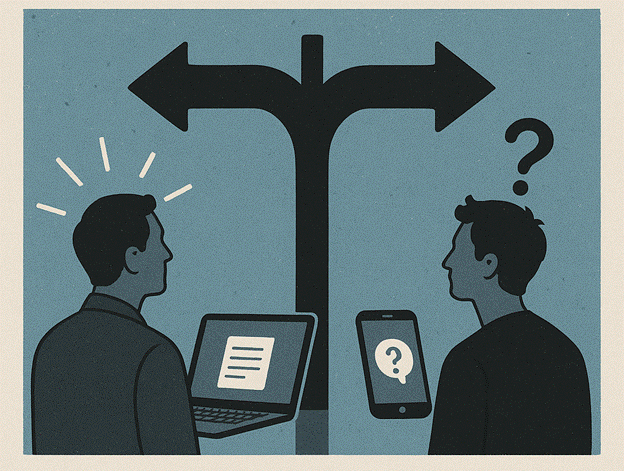
At this point, Pakistan faces a critical crossroad: will it promote an environment for shared knowledge or contribute to growing confusion? This is not about blaming technology or praising strict regulations. The true challenge lies in ensuring that platform design, human judgment, and public trust have a collaborative relationship that promotes truth rather than spreading misinformation. Authors, educators, politicians, leaders of platforms, and ordinary individuals all play a part. The question is urgent: will we allow technology to serve as an instrument of deception, or will we use it to promote clarity, connection, and mutual understanding?